
How a Simple Daily Routine Helped Me Stop Nagging My Kids (Well, Mostly).
If you’re a parent, you know the voice.
The one that nags, repeats itself, and sometimes makes you question every life decision that led you here. The voice that says, “Get up. Brush your teeth. Put on socks. Why are you still in your pajamas? We are leaving in five minutes.”
The voice that slowly transforms from a calm, loving parent into a broken Alexa device that nobody listens to.
Yeah. That voice.
After over a decade of parenting experience, I can honestly say that most days, it feels like I’ve achieved absolutely nothing. Not in a dramatic way. In a quiet, humbling, “How is it 8:17 AM and I am already exhausted?” kind of way.
And yet, some days, I am deeply grateful we are no longer in the toddler stage. Because if you know, you know.
You remember the days.
When getting out the door took over an hour for absolutely no logical reason.
When snow suits, boots, hats, and mittens had to be wrestled on like you were competing in an Olympic event called Extreme Layering.
When you finally got everybody dressed, zipped, buttoned, and ready to leave, only to smell something suspicious. Someone had done a number two, and you had to undo seventeen layers of clothing while silently bargaining with God.
And don’t even get me started on car seats. Securing a toddler into one required the strength, coordination, and teamwork of the entire Marvel franchise.
Ah yes. Character-building times.
Fast forward to now. The tween stage.
This is the stage where devices are basically oxygen. The stage where they can deliver a ten-minute TED Talk explaining why they need more screen time. The stage where they can argue with shocking confidence that their fart is actually impressive, possibly historic, and maybe even a gift to humanity.
And honestly, the confidence alone almost convinces you.
But here is the part nobody prepares you for. The nagging does not stop. It just evolves.
Because as a parent, it is literally your job to guide them. To teach them responsibility. To show them how to function in society without living off snacks and Wi-Fi alone.
Unfortunately, guidance repeated ten times starts to sound like nagging, even when your intentions are pure.
And that is the part that bothered me the most.
I did not want my voice to become the negative narrator in their heads. I did not want to be the voice they associate with pressure, frustration, or the feeling that they are never doing enough.
I want to be their safe place. Their calm. Their support.
Not their internal alarm system.
So I decided something had to change.
The Parenting Shift That Changed Everything: Giving My Kids Their Own System
Instead of continuing my career as Chief Executive Officer of Repeating Myself, I introduced something “revolutionary.”
Their own weekday schedule.
Not mine. Theirs.
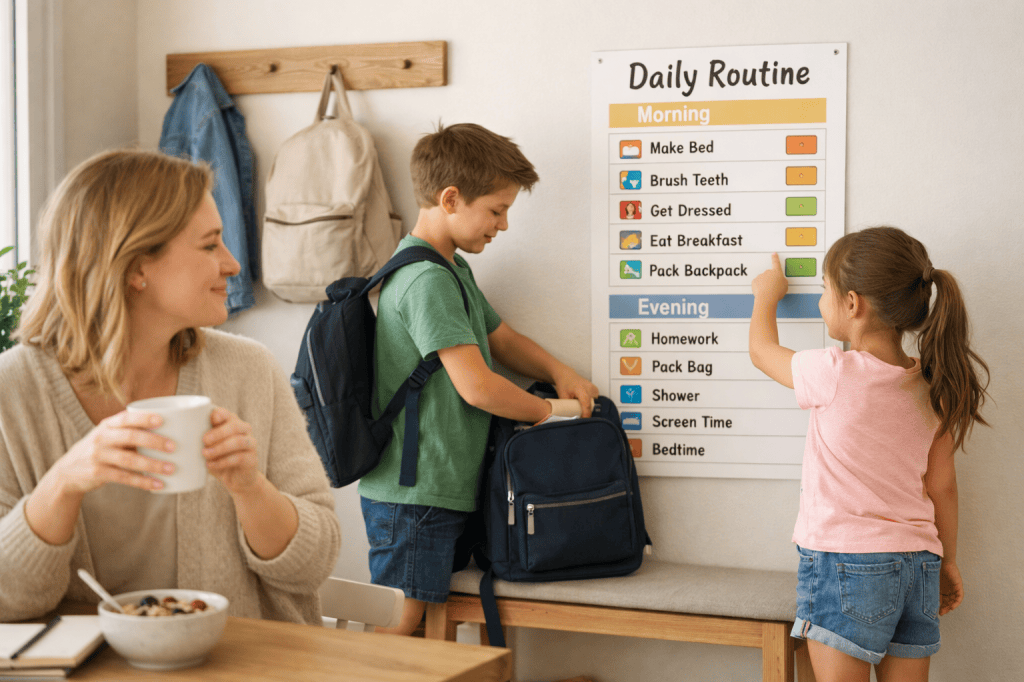
A simple, visual routine that shows them what needs to happen in the morning and evening without me having to announce every task like I am reading out the day’s agenda at a board meeting.
Here is what their routine looks like.
Morning routine:
- Wake up.
- Make the bed.
- Brush teeth.
- Shower.
- Get dressed.
- Grab breakfast.
- Leave the house.
Evening routine:
- Complete homework.
- Unpack school bags.
- Prepare clothes and bags for the next day.
- Follow the agreed screen time schedule.
- Get ready for bed.
Simple. Clear. Visible. Predictable.
No mystery. No surprises. No pretending you forgot that brushing your teeth was part of being a human.
The idea is to give them a clear picture of what needs to happen and allow them to take more responsibility for getting it done.
And if you are wondering whether this suddenly transformed our home into one of those perfectly organised households where children wake up smiling and parents sip their tea in peaceful silence, please keep reading.
The Unexpected Result: Less Nagging, Somewhat More Peace
Let me not come here and deceive anybody. The system works, but not always, and it certainly was not an overnight miracle.
We did not introduce a schedule on Monday and suddenly wake up on Tuesday in a home where everybody was organised, independent, and ready for school without supervision.
Please. Let us be serious.
We still sometimes have to send reminders through every communication system known to mankind. Verbal announcements, direct instructions, follow-up questions, and what I can only describe as a full emergency broadcast system.
Apparently, a schedule on the wall does not automatically make a child see, process, and act on information.
Who knew?
But so far, there is less nagging, and I will take that win.
I have some time in the morning to do other things, like log in to work and actually start my day while they shower, eat breakfast, and pack up for school.
I can drink my sacred morning tea and enjoy my overnight oats without narrating every single activity happening in the house like a live sports commentator.
Is it peaceful every morning? Absolutely not.
There is still the occasional, “Boy, why do you only have on ONE sock?”
Or the classic, “You should have asked me for that signature last night!”
And then there is the unexpected request for some document, permission slip, or mysterious school item that apparently became a matter of national importance at the exact moment we were scrambling out the door.
Because why would you tell me yesterday when we had the whole evening? Why would you do that when you can wait until we are practically halfway out of the house?
And somehow, I am the one expected to produce miracles before 8 AM.
Do they still forget things? Of course.
Do they occasionally behave as though packing a school bag is an unreasonable demand imposed by an oppressive government? Absolutely.
Do they suddenly develop the debating skills of a senior lawyer when asked to do something they do not feel like doing?
Without fail.
But overall, things are improving.
They are learning to take more ownership of their routines, and I am learning that I do not have to personally supervise every single movement for the day to go reasonably well.
And the best part is that I am trying to change the role my voice plays in their lives.
I want to guide them without becoming the constant soundtrack of everything they have forgotten to do. I want them to learn responsibility without feeling as though they are permanently disappointing me.
Because parenting is not just about getting them out of the house with clean teeth, matching socks, and all the required school supplies.
It is also about raising children who gradually learn to manage themselves, make decisions, and trust that they are capable.
If a simple weekday schedule helps us get there with a little less shouting and a little more peace, then we are onto something.
Why Visual Schedules Work Well for Kids
If you are constantly reminding your kids to get ready, finish their homework, pack their bags, or do the things you have already asked them to do seventeen times, you are not alone.
The mental load of parenting is real. Sometimes, it feels like you are the only person in the house with a functioning reminder system, and even your own brain is begging for annual leave.
A visual schedule will not magically transform your children into perfectly organized human beings. However, it can give them a structure to work with and give you one less thing to manage entirely on your own.
Here is why I think it helps.
1. Ownership Creates Responsibility
When children can see their routines and understand what is expected of them, they have an opportunity to take responsibility for completing those tasks instead of waiting for you to announce each one.
The goal is to move from “Mum told me to do it” to “I know what I need to do next.”
Will they get there overnight? No.
Will you still need to remind them sometimes? Please refer to the sock incident above.
But every little step counts.
2. Predictability Makes Mornings Easier
When the morning routine is clearly laid out, there is less room for the daily question, “What am I supposed to do now?”
They know they need to shower, get dressed, eat breakfast, and pack their things before leaving.
The routine is not a surprise. Nobody is springing the concept of brushing teeth on them for the first time at 7:45 AM.
Of course, knowing what to do and actually doing it are two entirely different things.
We are raising children, not running a military operation.
Still, having a predictable routine gives everyone a better starting point. It also makes it easier to identify what needs adjusting when something is not working.
3. The Schedule Becomes the Reminder, Not Just You
This is probably one of my favorite parts.
Instead of me being the only source of information in the house, the schedule is there for everyone to see.
Rather than immediately repeating myself, I can point them back to the list and encourage them to check what comes next.
That small change matters because I do not want every interaction with my children to feel like a correction.
I want to have conversations that are not always about what somebody has forgotten, what somebody has not done, or why somebody is standing in the kitchen with one sock on.
I have other things to discuss with these people. Their comedy alone provides enough material.
The schedule also gives me an opportunity to pause before repeating an instruction. Sometimes, they need a reminder. Other times, they need a little space to work through the task themselves.
I am learning to tell the difference.
Slowly. Very slowly.
4. It Builds Confidence and Independence
Every time children complete a task without being reminded, they get an opportunity to see that they can manage things for themselves.
It might seem like a small achievement to pack a school bag or follow an evening routine, but these little responsibilities help children practise independence.
The aim is not to get everything right every single time. It is to help them gradually build the skills they will need as they grow.
And honestly, watching your child do something independently without being asked fourteen times is a beautiful experience.
You might even shed a tear. Or you might simply enjoy your tea while it is still hot.
Both reactions are valid.
How to Stop Nagging Your Kids Without Losing Your Mind
If you are stuck in the cycle of repeating yourself until you no longer recognise the sound of your own voice, here is what I am trying in my home.
Give them ownership of their routines.
You do not need an elaborate system, expensive planners, or a colour-coded spreadsheet that requires three business days to understand.
Start with a simple weekday schedule that covers the things your children need to do in the morning and evening.
Keep it clear, age-appropriate, and easy to follow. Put it somewhere visible, involve them in understanding the expectations, and make sure they know how to use it.
Here is how you can get started.
Step 1: Create a Simple Morning Routine Chart
Write down the tasks your children need to complete before leaving for school.
For example:
- Wake up and make the bed.
- Shower and brush teeth.
- Get dressed.
- Eat breakfast.
- Pack the school bag and check for anything needed that day.
- Leave the house on time.
Adjust the order to suit your household. If breakfast comes before getting dressed in your home, do that. This is your routine, not a government-mandated sequence of events.
Step 2: Create an Evening Routine
A smoother morning often starts the night before.
An evening schedule might include:
- Complete homework.
- Unpack the school bag.
- Check school notices and permission slips.
- Prepare clothes and school supplies for the next day.
- Follow the agreed screen time limits.
- Get ready for bed.
This is also a good time to check whether anything needs a parent’s signature or whether there is a special item to bring to school.
Because nobody needs a surprise request for a signed permission form while standing at the front door with one shoe on.
We have suffered enough.
Step 3: Let Your Kids Participate
Rather than simply presenting the schedule as another set of instructions from management, explain why you are introducing it.
Talk about what needs to happen each morning and evening. Ask whether they think anything is missing, and make sure the expectations are realistic for their ages.
The aim is not to hand over all parental responsibility. You are still the parent, and guidance is still part of the job.
The aim is to help them understand their responsibilities and gradually take ownership of them.
Step 4: Give the System Time to Work
This part requires patience. And possibly tea. Lots of tea.
Your children will not necessarily follow the schedule perfectly from the first day. They may forget, get distracted, or suddenly discover that the wall chart is apparently invisible.
You may still need to follow up.
Try pointing them back to the schedule before automatically repeating the instruction. Give them an opportunity to check what comes next and complete the task themselves.
When something consistently goes wrong, look at the routine and see whether it needs adjusting.
Maybe there are too many tasks for the time available. Maybe the instructions are unclear. Maybe the screen time needs to end earlier so the evening routine can actually happen.
Or maybe somebody has simply decided that putting on socks is an unreasonable expectation.
You cannot win every battle. But you can keep working towards a routine that makes everyday life easier.
A Final Thought: I Am Raising Children, Not Trying to Win an Award for Perfect Parenting
Some mornings will still be chaotic. Some evenings will test your patience. Some days, you will wonder whether the schedule is helping at all.
But other days, you will sit with your tea, log in to work, and realise the children are getting on with their routines without needing you to narrate every step.
You will notice that they are learning, growing, and becoming more independent.
And perhaps, just perhaps, you will realise that you are also learning something.
You do not have to carry every reminder in your head. You do not have to be the family alarm clock, calendar, personal assistant, and chief executive of getting everybody out of the house.
You can create systems that support your family while giving your children the opportunity to grow into their responsibilities.
More importantly, you can remind them of what they need to do without making every forgotten task feel like a personal failure.
That is what I am working towards.
Not perfect children. Not perfect mornings. Not a home where nobody ever forgets anything.
Just a little more independence, a little less nagging, and a healthier balance between guiding my children and allowing them to figure things out.
Will I ever stop asking why somebody has only one sock on? Let’s not get ahead of ourselves.
But for now, there is less nagging, a little more breathing room, and a chance for me to enjoy my morning tea before it becomes a cold beverage with abandonment issues.
And honestly, I will take it.
A Little Note From Me
I am not a child psychologist, parenting expert, or professional in child development. I am simply a parent with over a decade of experience, learning as I go, making adjustments, and occasionally wondering who approved me for this position.
The routine I have shared is something I have tried in my own home, and it is what is working for us right now. Every child and family is different, so take what resonates and adapt what makes sense for yours.
We are all figuring it out, one morning, one reminder, and one missing sock at a time.
Balance & Bloom: Because finding balance does not mean getting everything right. Sometimes, it just means finding a better system.


